Showing posts with label Review. Show all posts

Saturday, May 21, 2022

Bangladesh-India Maitree Express Train will be re-launched on 29 May


The Maitree Express between Dhaka and Kolkata and the Bondhan Express between Kolkata and Khulna will be re-launched on 29 May 2022.


Maitree Express will start its journey from Dhaka. Bondhan Express will start its journey from Kolkata.


The Indian High Commission in Dhaka said this on Friday (May 19). The notice was published on the official website of Indian High Commission in Bangladesh.


The Mitali Express between New Jalpaiguri and Dhaka will start from New Jalpaiguri on June 1 after the virtual launch of the Railway Ministers of India and Bangladesh.


Passenger train communication between Bangladesh and India was closed for the last two years due to Covid-19 epidemic.


Thanks,


Related:

Subway Rail System in Dhaka City

LRT | Light Rail Transit Services in Narayangonj

Dhaka - Jashore in Two and Half Hours via Padma Bridge

Faridpur Bhanga to Mawa Rail Line

Dhaka City Metro Rail MRT Line6 will start in 2019

Dhaka-Ishwardi- Benapole Dual Gauge Rail Route

Rupsha Railway Bridge in Khulna-Mongla Rail Line

Dhaka to Kurigram Direct Express Train


Saturday, April 23, 2022

Dhaka Metrorail will Modern as Bangkok | Thai Ambassador


The Dhaka Metrorail (MRT Line-6) will be as modern as the Bangkok Metrorail, said Thai Ambassador in Bangladesh Mr. Makawadi Sumitmore, praising the progress of the Dhaka Metrorail 21 April, 2022.

After inspecting the site of the Metrorail project in Uttara, he told to the newspapers, "The quality and facilities of Dhaka Metrorail will be in line with our (Thailand's) standards."


The Ambassador visited the site as part of the commemoration of the 50th anniversary of diplomatic relations between Thailand and Bangladesh.

A leading Thai construction company, Italian-Thai Development Company PLC (ITD), is building a large section of Bangladesh's first metro rail (MRT Line-6).


Sumitmore said Thailand is involved in many economic cooperation efforts with Bangladesh and Dhaka Metrorail is one of the major projects. "Metrorail is an effective tool for improving the quality of life of the citizens and I am fascinated by the quality of work," he said.

The Ambassador hoped that the Metrorail project would help the people of the country to know more about Thailand's involvement and contribution in the development of Bangladesh. During the inspection, project manager Virat Kant explained the progress of the construction work.


Metrorail from Uttara to Agargaon is scheduled to open to the public by the end of this year and to Motijheel by December next year.

MRT Line 6 of Dhaka Mass Rapid Transit Development Project (MRT) is the country's first metro rail line from Uttara to Motijheel, 19.83 km long. It is divided into 8 contracts from CP-01 to CP-08.

According to the plan, MRT line 6 will be extended by 1.17 km to connect with MRT line-1 at Kamalapur railway station. ITD was awarded CP-03 and CP-04 in 2017 at a cost of BDT 37 billion. This includes construction of 9 elevated stations and viaduct from Uttara to Agargaon.


In addition, ITD has entered into a joint venture with foreign partners to work on other parts of the metro rail such as construction of warehouses and depots in Uttara North, construction of 4 elevated stations from Kawran bazar to Motijheel, construction of viaduct.

Project officials said ITD has created a total of about 6,000 jobs since construction began. ITD is involved in a number of infrastructure projects in Thailand and abroad, including the expansion of Suvarnabhumi Airport, Rupsha Bridge in Khulna, an integrated passenger terminal at Calcutta International Airport, and part of the National Highway Route NH-31C in West Bengal.

ITD has also assisted in the renovation of classrooms in Mariali Government Primary School. It is one of the two schools in Bangladesh participating in the Child and Youth Development Project under the auspices of Thai Princess Maha Chakri Sirindharna.

Thanks,


Related:

Subway Rail System in Dhaka City

Dhaka Metrorail has Completed Performance Test

LRT | Light Rail Transit Services in Narayangonj

Dhaka - Jashore in Two and Half Hoursvia Padma Bridge

Faridpur Bhanga to Mawa Rail Line

Dhaka City Metro Rail MRT Line 6 willstart in 2019

Dhaka-Ishwardi- Benapole Dual GaugeRail Route

Rupsha Railway Bridge in Khulna-Mongla Rail Line

Dhaka to Kurigram Direct Express Train

Dhaka - Chattogram Double Track Railway Update

Dhaka-Mawa-Bhanga Expressway has been Inaugurated

Master Plan around Karwan Bazar

Wednesday, March 23, 2022

Payra Power Plant Inauguration | Hundred Percent Electrification


Prime Minister Sheikh Hasina has announced 100 percent electrification of the country. Shee made the announcement at a rally at Monday, 21st March, 2022. Earlier, Prime Minister Sheikh Hasina inaugurated the country's largest Payra power plant at Kalapara in Patuakhali. She inaugurated the “Payra 1320 mw thermal power plant” at 11:48 on Monday.


The Prime Minister reached the Payra power plant area at 10:42 am to inaugurate the Payra Thermal Power Station. Later at 11:15 am, Sheikh Hasina waved the flag and greeted 200 boats on the Rabnabad River adjacent to the jetty of Payra Thermal Power Plant. At this time, the diversity of life of the people of the coast is highlighted through this boat exhibition. 


The Rabnabad river area was abuzz with various banners, festoons and slogans including song distribution on the boat. At that time, the Prime Minister waved his hand and greeted the fishermen in the boat. The Prime Minister was also seen capturing scenes of the boat show from his mobile. In the morning the boats were lined up at the mouth of the Rabnabad river. Of these, 100 boats were sailing, 100 boats had banner festoons with pictures of the Prime Minister and the remaining 20 boats had security personnel. A total of 880 fishermen in 4 different colors in each boat welcomed the Prime Minister.


Later, the Prime Minister participated in a cordial meeting organized at the Payra power plant. From this auspicious gathering, the Prime Minister announced 100% electrification in the whole country. Prime Minister Sheikh Hasina has said that the country is on the highway of development today as the democratic trend has continued in the country for the last 13 years. The government has succeeded in providing electricity to every household in the country.


Prime Minister Sheikh Hasina inaugurated the country's largest Payra 1320 mw thermal power plant at Kalapara in Patuakhali.


The Payra 1320 MW Thermal Power Plant is a 1,320 megawatt coal-fired power station built in Kalapara Upazila of Patuakhali District in southern Bangladesh. The Payra area in Patuakhali is going to be a major economic hub with a sea port, a special economic zone, an airport and the country's biggest coal-fired power plant that officially launched.

Source: BD-Pratidin


Thanks,


Related:

Thursday, February 17, 2022

BSMMU Super Specialized Hospital Awaiting Inauguration


New and most modern feathers are being added to the healthcare system of the country. Multi Disciplinary and Super Specialized Hospital is going to start the journey in Bangladesh soon. All kinds of health services will be available in this new super specialized hospital. The construction work of this hospital established on 12 bighas of land in Shahbagh of the capital city Dhaka under BSMMU, the work of purchasing required medical and hospital equipments has been completed.

This Super Specialized Hospital is scheduled to be inaugurated next June after completing the rest work. Renowned Surgeon, Professor of Bangabandhu Sheikh Mujib Medical University (BSMMU), Project Director. Md. Zulfiqar Rahman told a Newspaper that in his 40 years of working life, he has worked in various hospitals across the country as well as in famous hospitals in UK and Singapore. He said that in our country, patients have to go to different places depending on the disease. To alleviate this suffering, the dream was to build a world class hospital with all services. With the tireless efforts of Prime Minister Sheikh Hasina, this hospital will bring a tide of change in the health sector of the country.

Hospital management is being developed by fully digitalizing it. All patient information will be stored through the Hospital Information Center (HIS). All types of healthcare services will be provided through five different centers in this hospital. Patients will get all the services under one roof. He also said that 140 people including doctors, nurses and health workers will be trained in Korea on services and management in the hospital. Training of 50 people is going on, another batch will go to Korea next in April.


The hospital will be modeled on the National University Hospital of the All India Institute of Medical Sciences, Singapore. Joint Commission International (JCI) accreditation must be ensured to maintain the quality of services in the hospital. With this, the approval of the National Accreditation Board for Hospitals and Health Care (NABH) has to be introduced. The construction work of the hospital is completely finished.

A consignment of equipments has arrived at Chittagong port. All the work including the fitting of these equipments will be completed by the month of May. The hospital will be inaugurated in June and the admission of patients will start. With its launch, BSMMU's education, medical and research activities will be more dynamic and improved.

The initiative of this super specialized hospital was taken in 2012 on 3.8 acres (about 12 bighas) of land on the north side of BSMMU. The project was approved by the Executive Committee of the National Economic Council (ECNEC) on February 2, 2016 at a cost of Tk 1,366 crore. On September 13, 2018, the Prime Minister laid the foundation stone of the project. A loan of Tk 1,047 crore has been received from the South Korean government for the construction of the hospital. Hyundai Corporation Korea is completing the construction work.

The hospital was designed by SUNJIN Engineering & Architecture Co. Ltd, Korea. The multi-disciplinary and super specialized hospital with 12 floors and three basements will have 750 beds. Around 7,000 patients will get service from its outdoor department every day. It has 100 ICU beds and emergency beds. Five different centers include Emergency Medicine, Maternal and Child Health Center, Cardiovascular Center, Hepatobiliary and Gastroenterology Center and Kidney Disease Center.


There will be twelve state-of-the-art operating theaters, where high quality surgeries, including various organ transplants, will be performed. The hospital project is arranged on these two bases: Hospital construction and Advanced training. Professor Dr. Md. Zulfiqar Rahman Khan said that there are 73 cabins in this specialized hospital. Of these, 6 will be for VVIP’s, 21 for VIP’s and the rest will be deluxe cabins.

The hospital will also have ward, surgical intensive care, medical intensive care, coronary care unit, neonatal intensive care unit and pediatric intensive care unit. The patient does not have to go anywhere else to get services in this specialized hospital. Inside the hospital there will be banking facilities, pharmacy, four cafeterias. There will be 16 elevators and an escalator, fire management, heating, ventilation and air conditioning systems. Activities will be controlled digitally from the central control room through CCTV cameras.


This hospital will open a new horizon in Bangladesh’s medical sector. Not only the rich people, the lower and middle class families of the country will get a greater scope to receive special treatment here.


Thanks,


Related:

Wednesday, January 26, 2022

A New Mymensingh City Beside Brahmaputra River


For more than two decades, the Brahmaputra River has been the lifeblood of Mymensingh. The river that made waves after waves is now silent. There are dead canal somewhere. Experts have come to think about the turbulent state of the turbulent river. But all the plans flew in the sky like a fairy of imagination, did not even show the desire to touch the ground.

However, due to the will of the Prime Minister Sheikh Hasina, neglect of the River has end. The river caught her eye. And now the oldest Mymensingh is changing around this river. After the declaration of Mymensingh as a division on 13 October 2015, various master plans were taken around the Brahmaputra River. The initiative was taken at the divisional headquarters on the other side of the river. When the municipality was transformed into a city corporation in October 2018, some new wards of the Char area were also included.


Today's Mymensingh is being built along the banks of the Brahmaputra, which runs through the heart of the city. An extended part of the city will be built on the other side. The people of Mymensingh will see a beautiful new city with latest facilities. The combination of old and new will unite this Mymensingh city with three bridges. 

In a meeting of the Executive Committee of the National Economic Council (ECNEC) in last year approved the construction of a bridge at a cost of about Tk 3,500 crore, which will be built in the Kewatkhali area of ​​the city. The 1,100-meter arched four-lane bridge will be modeled on Australia's Sydney Harbor Bridge, the first in the country's history. When the construction of the bridge is completed in June 2025, the communication facilities of Mymensingh with Netrokona, Sherpur and Kishoreganj districts will increase. Besides, trade between Nakugaon and Haluaghat land ports with the capital Dhaka will increase. There are also plans to build two more bridges through Ghagdahar and Kacharighat-adjacent Zero Point areas.


On the other hand, the Ministry of Public Administration has given administrative approval to set up the much awaited divisional headquarters on 945.219 acres of land on the other side of the river. The Divisional Land Commissioner hoped that the DPP and TAPP of the headquarters would be finalized and sent to the project ministry in the shortest possible time.

The Divisional Commissioner said that Prime Minister Sheikh Hasina has directed for proper compensation and dignified rehabilitation of the people of the acquired area. The present government has issued a notification to triple the value of the acquired land. So the victims will get a lot of land. 25 acres of land has been set aside for the affected people in the acquired area. They will be rehabilitated there. The rehabilitation process will start first.


Earlier, Prime Minister Sheikh Hasina had given various instructions in a meeting at her office on September 17, 2016 to set up the Mymensingh divisional headquarters. Mymensingh is the twelfth city corporation of the country. From 21.73 sq km, the city is now 90.17 sq km. In 2020, the ECNEC was sanctioned Tk 1,575 crore to make this city a modern city. The newly expanded 68.44 sq km area has not seen any development. The City Corporation is spending the money on overall development including road development, expansion of drainage system, over bridges, footpaths etc.

With a population of over eight lakhs, this city is slowly being transformed into the smart city, which is now very much visible. Gauripur and Ishwarganj upazilas situated on the other side of the Brahmaputra River. The district administration has proposed to make an economic zone within Mymensingh city and those two upazilas. This was stated by Aminul Haque Shamim, President, Mymensingh Chamber of Commerce and Industry. He said there are plans to set up economic zones on 500 acres of land. If it is implemented, timely decision will be taken.


Mentioning the reason for this, he said that excavation work has been started to restore the navigability of the river. 30 percent of the work has been completed. With the return of full navigability, the communication of goods in the designated economic zone with the port will be easier as well as financially viable. Employment will be directly to two lakh people.

However, towards the end of 2011, there was a touch of development in Mymensingh. The four-lane road from Joydebpur crossroads in Gazipur to Mymensingh in an 88 km stretch changed the landscape of Mymensingh. The highway is about 63 feet wide. The width is even greater next to markets and business centers. The road was officially inaugurated in July 2016 at a cost of BDT 1,800 crore. And with the help of such communication system, Bhaluka and Trishal are now upazilas of heavy industrial area.

Soon the Mymensingh will be one of the most beautiful cities in the country.

Thanks,


Related:

Sunday, January 9, 2022

European Standard Mahalchhari – Sindukchhari - Jalliapara Road


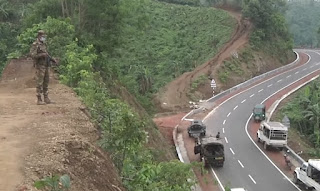
Last year, The Engineering Corps of the Bangladesh Army has constructed a new 15.5 km long hill road from Guimara in Khagrachhari to Mahalchhari.  Using this road, people of Rangamati, Khagrachhari and Bandarban districts will now be able to move fast across the country including Dhaka without entering Chittagong city. This will save three hours for the people of Rangamati to reach Dhaka. The path will be reduced to 68 kilometers. Mahalchhari-Sindukchhari-Jalliapara of the Ministry of Road Transport and Bridges


The road was constructed by 20 Engineer Construction Battalion under the supervision of 34 Engineers Construction Brigade of Bangladesh Army. The construction work started in February 2019 and will be completed by December 2021, but it was completed in June 2021. As a result, although not officially inaugurated, the road has been opened to public traffic.


The main carpeting road is 18 feet wide. Outside, the hard solder (brick road on both sides) is about 11 feet. The road has 24 km side drain, 28 m culvert, 410 m gravity wall, 630 m retaining wall and 800 m parasiding.


Mahalchhari-Sindukchhari-Jalliapara road construction project director and 20 ECB captain Lt. Colonel Md. Amjad Hossain Didar said that the time and distance of inter-regional communication between Khagrachhari and Rangamati region will be greatly reduced through this road. The transportation and marketing of goods produced in the hilly areas will be much faster and will contribute to the expansion of the tourism industry. He said that at every stage of the construction project, emphasis is laid on carrying out development work without cutting down the hills and without harming the environment. The road will also be helpful in working on regional and internal security issues.


Major SM Khaledul Islam, project officer of the Mahalchhari-Sindukchhari-Jalliapara road construction project, said advanced engineering and technology have been utilized at every stage of the road construction. Advanced construction materials have been used. The people of the area will get the benefits.


The new road has gone through the green hills. Green vegetables planted on zoom farms on both sides and farms are growing. Many local Bengalis and hill families went out to walk on the road. A young man named Chapal Chakma said that there is a road to Khagrachhari through Mahalchhari. That is very inaccessible. The people of the area are very happy because of the new road.


Thanks,


Related:

Subway Rail System in Dhaka City

LRT | Light Rail Transit Services in Narayangonj

Dhaka - Jashore in Two and Half Hoursvia Padma Bridge

Faridpur Bhanga to Mawa Rail Line

Dhaka City Metro Rail MRT Line 6 will start in 2019

Dhaka-Ishwardi- Benapole Dual GaugeRail Route

Rupsha Railway Bridge in Khulna-Mongla Rail Line

Dhaka to Kurigram Direct Express Train

Dhaka - Chattogram Double Track Railway Update

Dhaka-Mawa-Bhanga Expressway has been Inaugurated

Master Plan around Karwan Bazar 

Wednesday, December 8, 2021

Steel Industries in Bangladesh Exporting Billet


Billet is the middle raw material in rod production. This billet is heated and molded to make iron bars (rods). Even five years ago, this important raw material for making steel and iron products was dependent on imports. However, with the initiative of private sector entrepreneurs, that situation has now completely changed.

However, the policy of raising tariffs on imports, including coming out of the power crisis, has played a big role in this sector. The demand for billets was around 4 million tons a year even five years ago. At that time the amount of import was about 18 lac tons. Apart from this, the demand of about 21-22 lac tons was met by collecting billets and ship-breaking iron plates made in the country. But by increasing the production capacity locally in last five years, the entrepreneurs have completely changed that situation.


Although the annual demand is increasing now, almost all of it is being made in the country. Besides, billets have now started to be exported. Instead of intermediate raw material billets, now the raw material for making billets is old iron pieces. At one time billets were made only in Chittagong Steel Mills in Bangladesh. Apart from billets, ingots and corrugated sheets were also produced in this government factory.

Before the government closed the Chittagong Steel Mills, the BSRM group took the first initiative to set up a billet factory in the country in 1996. At present, BSRM, Abul Khair Group, GPH Ispat and KSRM are producing more than 90 per cent of the billet capacity in the country. China is the world's leading steel producer. The lion's share of billet imports to Bangladesh also came from China. And for the first time in that country, GPH Steel has shown the achievement of exporting billets from Bangladesh. GPH Group, currently the most enterprising billet exporter, has already exported one lac tons to China in four ships. Talks are now underway on billet exports to Dubai. Billets will be exported to the country only if they can ensure the price as per the demand.


Earlier, the company's first billet export started in 2009 in Sri Lanka. GPH Steel is producing billets using the latest technology of electric arc furnace 'Quantum EAAF' at the world's most advanced technology steel factory on the Dhaka-Chittagong highway in Kumira area of ​​Sitakunda, Chittagong. In rod or billet production it is much more environmentally friendly and electricity-gas efficient than any other consideration. GPH Steel has taken steps to increase the annual billet production capacity to 1 million tons by combining new and old factories.

Even a few years ago, the rod factories did not have the capacity to make billets as per the demand. But now the picture is different. At the import stage, GPH are producing billets by melting old iron by setting up factories with new investment in a positive step of the customs-tax government policy. They are also exporting that billet.


The most important thing in this case is to ensure quality. They have a plan to increase exports to a large scale soon if there is government policy support including global branding while maintaining quality standards. By ensuring quality, it is possible to bring export success not only to China, but to any country in the world. The mission of the Prime Minister's Vision 2041 is being given good importance in our action plan.


Thanks,


Related:

Subway Rail System in Dhaka City

LRT | Light Rail Transit Services in Narayangonj

Dhaka - Jashore in Two and Half Hoursvia Padma Bridge

Faridpur Bhanga to Mawa Rail Line

Dhaka City Metro Rail MRT Line 6 will start in 2019

Dhaka-Ishwardi- Benapole Dual GaugeRail Route

Rupsha Railway Bridge in Khulna-Mongla Rail Line

Dhaka to Kurigram Direct Express Train

Dhaka - Chattogram Double Track Railway Update

Dhaka-Mawa-Bhanga Expressway has been Inaugurated

Master Plan around Karwan Bazar

Steel and Iron Industry of Bangladesh

Sunday, November 28, 2021

Steel and Iron Industry of Bangladesh


The steel sector is a highest investment sector in the world. The development of a country is considered by calculating the per capita steel consumption of that country. At present, the average per capita steel consumption in Bangladesh is 45 kg. In view of the growing economy, especially the infrastructural development of the government, it is expected that the demand will increase to more than 70 kg in the next two years. The iron industry has been growing in the country since 1990. In the nineties, entrepreneurs came forward to invest in the sector one by one. Then the raw material of the rod became easily available for the old iron of breaking ship. Although the initial three decades have been in the traditional way, the country's steel sector is growing by relying on private sector investment, diversifying products and transforming into production.

Top entrepreneurs of the country say that the production capacity is being increased in advance keeping in mind the future demand of steels inside Bangladesh. One by one new and high-powered specialized rods are being added to the list of products. For this, of course, industries have to face new challenges. Due to the COVID-19 epidemic, the factories have been closed for a long time and huge losses have been incurred. Entrepreneurs are worried about paying their employees and even keeping the business running. Even though the factories have been reopened, they have recently suffered the most due to the scarcity of melting scrap in the world market. However, after the disaster, the country's heavy industrial sector has now started to turn around.

According to the Steel Manufacturers Association and Entrepreneurs, even 10 years ago, the combined production of MS rods in the country was 2.5 million tons per year. At present, the average annual production and marketing is about 6 million tons according to the demand. However, the combined production capacity of steel (rod) has now been increased to 9 million tonnes due to factory expansion measures of several companies including GPH. The pace at which the capacity of the factory is being expanded will increase to 10 million MT in the next two years. And then the production of MS rod will release an average of 7 million tons per year. The total investment of entrepreneurs in this sector is about BDT 50 thousand crore. At present about three lac people are directly and indirectly involved. The main reason for the growth of the steel industry in the last few years is the implementation of mega projects in the public sector, development of economic zones, power plants, construction of houses in the villages. In this context, the entrepreneurs focus on increasing production by expanding modern technology and factories.


BSRM:

Speaking of the country's steel sector, the name BSRM comes first. The East Bengal Steel Re-rolling Mills, established in the Nasirabad industrial area of ​​Chittagong in 1952, was renamed Bangladesh Steel Rolling Mills or BSRM after independence. The first generation of the company was started by Akbar Ali Afrikawala. Later the current chairman of the group, Mr. Ali hossain son of founder Akbar Ali Afrikawala has been leading the company for almost 40 years. Changes in the quality of steel, including the manufacture of high-strength rods, have come about through his hands. There is no big or important project in the country where BSRM rods are not being used. The eight factories of BSRM Group now have an annual rod production capacity of 1.6 million tonnes and billet production capacity of 1.8 million tonnes. However, BSRM is moving ahead with the aim of increasing the combined production capacity to 4 million tonnes in both the cases. The company, which started about 68 years ago, is expanding its business using only its skills and experience in the steel sector. In 1983, BSRM started making quality products by bringing automatic machines from United Kingdom. The following year brought a variety of products to the sector with high-strength ‘cold-twist steel rods’. Then in 1987 BSRM took the first step to produce high quality 60 grade rods of international standard. Later, the Extreme 500W was launched in 2008. These 500W rods have more power than 60 grades. Marketing of the 80-grade BSRM Maxima began in 2015 for the construction of high-rise installations, nuclear power plants, tunnels and major bridges. BSRM is also preparing special rods of salinity corrosion for earthquake prone areas and coastal areas. BSRM is now setting up factories in Kenya and expanding business in Hong Kong.


AKS:

Another major giant in the steel sector is the Chittagong-based Abul Khair Group. Although flat steel was introduced in 1993 through corrugated steel production, rod production started in 2009. The company is marketing the rod under the AKS brand name. In the steel market, the production of steel in the first electric arc furnace in the country started with their hands. Abul Khair Group's steel plant has a rod production capacity of 1.4 million tons per year. Considering the market share, Abul Khair Group has established itself as a strong competitor of BSRM with long experience. The first TMT (Thermo Mechanically Treated) bar or rod in the country they bring to market. The company has also established a strong position in making billets. Abul Khair's group is self-sufficient in making about 1.2 million tons of billets.


KSRM:

Chittagong-based KSRM (Kabir Steel Re-Rolling Mill), the third largest steel market in the country, has been producing steel rods since 1984. Mohammad Shahjahan is the main entrepreneur of KSRM. The company initially had a production capacity of 150,000 tonnes with a semi-re-rolling mill. Europe's Pomini technology has later increased the production capacity of its own factory rods to eight million tons. The company is also working to increase the production of raw material billets between rods from six lakh to eight lakh tonnes. KSRM Factory is a 'Composite Steel Factory'. Such factories are producing rods of international standard by maintaining quality at every step from primary raw material (scrap) to rod production. At present, KSRM produces 55 lac cyclic load tolerant rods at 369 mega fingles. The company is also in the forefront of importing old ships to ensure the supply of raw materials for steel.


GPH Ispat:

GPH Steel has brought modern technology electric arc furnace through big investment in steel sector. The use of this technology produces the highest paid rods in a short time. Although the level of pollution depends on the type of industry, the quality of the infrastructure, the technology used and the management skills, the amount of damage is very small in the quantum arc furnace technology of GPH steel. GPH Ispat Limited's new factory is also ahead in efficient use of water. The world's most advanced technology has been used to treat wastewater here. In this system there is no chance of any waste or contaminated water going out. Rather it is conducive to the natural environment by purifying and reusing all waste water. Production is now underway at a new factory at Kumira in Sitakunda, Chittagong, at a cost of about Tk 2,500 crore. The company started steel production in 2008 at an auto factory in Sitakunda. However, the construction of the new factory started in February 2017 as its position in the local market continued to be strong. If fully operational, the company's annual rod production capacity, including new and old factories, will stand at about 1 million tons. Besides, the old GPH factory has an annual billet production capacity of 1 lac 68 thousand tons but the expanded new factory will produce 8 lac 40 thousand tons of billets. The new factory will have 500 W TMT bar and rods of different grades as well as various materials for construction of pre-fabricated buildings including sections, angles, channels, H beams, I beams. GPH products have been exported to several Indian states, including Sri Lanka and China. Last year, GPH Steel also had the credit of exporting billets from Bangladesh to the Chinese market for the first time.


Anwar Ispat:

Anwar Group is expanding the factory step by step by calculating the domestic demand of the steel sector. Khaled Iron and Steel Mills Limited was renamed as Anwar Ispat Limited in 2000. The company currently has a production capacity of 300,000 tons per year. Besides, billet production capacity is more than 1 lac 90 thousand tons. The company is working with the goal of increasing the existing capacity.

Manohar Hossain, current president of the Bangladesh Steel Manufacturers Association (BSMA) and managing director of Anwar Group, said, ‘Steel is a high-cost industrial sector. Where sales are more visible but profits are lower. The country is producing world class steel suitable for use in any important installation. Large projects require a lot of steel products. This growth of steel products will continue for the next 10 years. There is now more production capacity than demand. The combined production capacity of local entrepreneurs has now exceeded 5.5 million tonnes per annum. Entrepreneurs are working to increase the efficiency of using energy, chemicals and water in setting up or expanding factories. Entrepreneurs have to calculate additional compensation from waiting for the ship at normal time. This is having an impact on the economy by increasing costs. The country's steel sector will return to the desired growth after overcoming the slowdown in the steel market due to the corona.


Rahim Steel:

A subsidiary of Rahim Group in the steel sector, started its journey in 1968. By setting up a re-rolling mill, 40 grade rods were made in its factory from the beginning. However, being able to ensure quality to the customer increased the demand and at the same time the second factory was built in 1976. At present Rahim Steel is producing various types of steel products including 500 TMT bar, hot rolled plate, billet, shaft round bar. They are also demanding to market earthquake resistant rods in the country first.


Mostafa Hakim Group:

Mostafa Hakim Group has built expertise in the production and marketing of steel products for four decades. The group's two affiliates Golden Steel Limited and HM Steel and Industry have also recently expanded their business in the steel market. Golden Steel Limited's steel production capacity was 2.5 lac tons per annum. However, from this year, the production capacity has been increased to seven lac tons per annum through HM Steel, another subsidiary of Mostafa Hakim Group. The company is providing quality rods for the construction of economic zones including ongoing mega projects.


Bayazid Steel:

Bayazid Steel traveled to Nasirabad in Chittagong in 1986 holding the hand of entrepreneur Abu Bakar Chowdhury. Belgium's Temco technology was used in the factory in 2010 to produce rods. At present the production capacity is about one lac tons per year. The company has a rod making factory as well as a billet factory.


BSI:

The Bandar Steel Industries (BSI) factory at Madanpur in Narayanganj was established in 2002. Together with the automated re-rolling they make billet and BSI brand rods. Their products are fatigue tested from the United States. Seema Steel started in 1991 with the shipwreck. Boundary automatic re-rolling mills have been producing steel rods since 2003. The company's factory at Sitakunda has an annual production capacity of 60,000 tons.


Among the leading companies in steel production are RSRM Steel, Magnum Steel Industries, SSRM. Apart from this, there are many small and traditional factories in the steel sector. Expert said that the steel is the biggest sector among construction materials. The market size of Steel sector of Bangladesh will be around 50 thousand crore BDT. Numerous big projects are being implemented in the public sector. It will increase continuously for the next 10 years i.e. till 2030. There is no substitute for using the latest technology to ensure the highest quality in steel products. That's why companies have come forward to use the latest technology, even if the investment is high. Iron ore, coal, limestone and small quantities of old iron are used as raw materials in basic factories. Bangladesh will at some stage move towards the basic steel industry, that is the expectation.


Thanks,


Related:

Subway Rail System in Dhaka City

LRT | Light Rail Transit Services in Narayangonj

Dhaka - Jashore in Two and Half Hoursvia Padma Bridge

Faridpur Bhanga to Mawa Rail Line

Dhaka City Metro Rail MRT Line 6 willstart in 2019

Dhaka-Ishwardi- Benapole Dual GaugeRail Route

Rupsha Railway Bridge in Khulna-Mongla Rail Line

Dhaka to Kurigram Direct Express Train

Dhaka - Chattogram Double Track Railway Update

Dhaka-Mawa-Bhanga Expressway has been Inaugurated

Master Plan around Karwan Bazar

Steel Industries in Bangladesh Exporting Billet