Showing posts with label Blue Economy. Show all posts

Sunday, January 9, 2022

European Standard Mahalchhari – Sindukchhari - Jalliapara Road


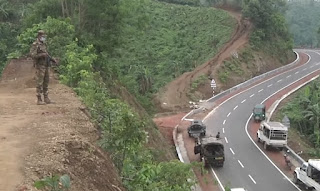
Last year, The Engineering Corps of the Bangladesh Army has constructed a new 15.5 km long hill road from Guimara in Khagrachhari to Mahalchhari.  Using this road, people of Rangamati, Khagrachhari and Bandarban districts will now be able to move fast across the country including Dhaka without entering Chittagong city. This will save three hours for the people of Rangamati to reach Dhaka. The path will be reduced to 68 kilometers. Mahalchhari-Sindukchhari-Jalliapara of the Ministry of Road Transport and Bridges


The road was constructed by 20 Engineer Construction Battalion under the supervision of 34 Engineers Construction Brigade of Bangladesh Army. The construction work started in February 2019 and will be completed by December 2021, but it was completed in June 2021. As a result, although not officially inaugurated, the road has been opened to public traffic.


The main carpeting road is 18 feet wide. Outside, the hard solder (brick road on both sides) is about 11 feet. The road has 24 km side drain, 28 m culvert, 410 m gravity wall, 630 m retaining wall and 800 m parasiding.


Mahalchhari-Sindukchhari-Jalliapara road construction project director and 20 ECB captain Lt. Colonel Md. Amjad Hossain Didar said that the time and distance of inter-regional communication between Khagrachhari and Rangamati region will be greatly reduced through this road. The transportation and marketing of goods produced in the hilly areas will be much faster and will contribute to the expansion of the tourism industry. He said that at every stage of the construction project, emphasis is laid on carrying out development work without cutting down the hills and without harming the environment. The road will also be helpful in working on regional and internal security issues.


Major SM Khaledul Islam, project officer of the Mahalchhari-Sindukchhari-Jalliapara road construction project, said advanced engineering and technology have been utilized at every stage of the road construction. Advanced construction materials have been used. The people of the area will get the benefits.


The new road has gone through the green hills. Green vegetables planted on zoom farms on both sides and farms are growing. Many local Bengalis and hill families went out to walk on the road. A young man named Chapal Chakma said that there is a road to Khagrachhari through Mahalchhari. That is very inaccessible. The people of the area are very happy because of the new road.


Thanks,


Related:

Subway Rail System in Dhaka City

LRT | Light Rail Transit Services in Narayangonj

Dhaka - Jashore in Two and Half Hoursvia Padma Bridge

Faridpur Bhanga to Mawa Rail Line

Dhaka City Metro Rail MRT Line 6 will start in 2019

Dhaka-Ishwardi- Benapole Dual GaugeRail Route

Rupsha Railway Bridge in Khulna-Mongla Rail Line

Dhaka to Kurigram Direct Express Train

Dhaka - Chattogram Double Track Railway Update

Dhaka-Mawa-Bhanga Expressway has been Inaugurated

Master Plan around Karwan Bazar 

Wednesday, December 8, 2021

Steel Industries in Bangladesh Exporting Billet


Billet is the middle raw material in rod production. This billet is heated and molded to make iron bars (rods). Even five years ago, this important raw material for making steel and iron products was dependent on imports. However, with the initiative of private sector entrepreneurs, that situation has now completely changed.

However, the policy of raising tariffs on imports, including coming out of the power crisis, has played a big role in this sector. The demand for billets was around 4 million tons a year even five years ago. At that time the amount of import was about 18 lac tons. Apart from this, the demand of about 21-22 lac tons was met by collecting billets and ship-breaking iron plates made in the country. But by increasing the production capacity locally in last five years, the entrepreneurs have completely changed that situation.


Although the annual demand is increasing now, almost all of it is being made in the country. Besides, billets have now started to be exported. Instead of intermediate raw material billets, now the raw material for making billets is old iron pieces. At one time billets were made only in Chittagong Steel Mills in Bangladesh. Apart from billets, ingots and corrugated sheets were also produced in this government factory.

Before the government closed the Chittagong Steel Mills, the BSRM group took the first initiative to set up a billet factory in the country in 1996. At present, BSRM, Abul Khair Group, GPH Ispat and KSRM are producing more than 90 per cent of the billet capacity in the country. China is the world's leading steel producer. The lion's share of billet imports to Bangladesh also came from China. And for the first time in that country, GPH Steel has shown the achievement of exporting billets from Bangladesh. GPH Group, currently the most enterprising billet exporter, has already exported one lac tons to China in four ships. Talks are now underway on billet exports to Dubai. Billets will be exported to the country only if they can ensure the price as per the demand.


Earlier, the company's first billet export started in 2009 in Sri Lanka. GPH Steel is producing billets using the latest technology of electric arc furnace 'Quantum EAAF' at the world's most advanced technology steel factory on the Dhaka-Chittagong highway in Kumira area of ​​Sitakunda, Chittagong. In rod or billet production it is much more environmentally friendly and electricity-gas efficient than any other consideration. GPH Steel has taken steps to increase the annual billet production capacity to 1 million tons by combining new and old factories.

Even a few years ago, the rod factories did not have the capacity to make billets as per the demand. But now the picture is different. At the import stage, GPH are producing billets by melting old iron by setting up factories with new investment in a positive step of the customs-tax government policy. They are also exporting that billet.


The most important thing in this case is to ensure quality. They have a plan to increase exports to a large scale soon if there is government policy support including global branding while maintaining quality standards. By ensuring quality, it is possible to bring export success not only to China, but to any country in the world. The mission of the Prime Minister's Vision 2041 is being given good importance in our action plan.


Thanks,


Related:

Subway Rail System in Dhaka City

LRT | Light Rail Transit Services in Narayangonj

Dhaka - Jashore in Two and Half Hoursvia Padma Bridge

Faridpur Bhanga to Mawa Rail Line

Dhaka City Metro Rail MRT Line 6 will start in 2019

Dhaka-Ishwardi- Benapole Dual GaugeRail Route

Rupsha Railway Bridge in Khulna-Mongla Rail Line

Dhaka to Kurigram Direct Express Train

Dhaka - Chattogram Double Track Railway Update

Dhaka-Mawa-Bhanga Expressway has been Inaugurated

Master Plan around Karwan Bazar

Steel and Iron Industry of Bangladesh

Sunday, November 28, 2021

Steel and Iron Industry of Bangladesh


The steel sector is a highest investment sector in the world. The development of a country is considered by calculating the per capita steel consumption of that country. At present, the average per capita steel consumption in Bangladesh is 45 kg. In view of the growing economy, especially the infrastructural development of the government, it is expected that the demand will increase to more than 70 kg in the next two years. The iron industry has been growing in the country since 1990. In the nineties, entrepreneurs came forward to invest in the sector one by one. Then the raw material of the rod became easily available for the old iron of breaking ship. Although the initial three decades have been in the traditional way, the country's steel sector is growing by relying on private sector investment, diversifying products and transforming into production.

Top entrepreneurs of the country say that the production capacity is being increased in advance keeping in mind the future demand of steels inside Bangladesh. One by one new and high-powered specialized rods are being added to the list of products. For this, of course, industries have to face new challenges. Due to the COVID-19 epidemic, the factories have been closed for a long time and huge losses have been incurred. Entrepreneurs are worried about paying their employees and even keeping the business running. Even though the factories have been reopened, they have recently suffered the most due to the scarcity of melting scrap in the world market. However, after the disaster, the country's heavy industrial sector has now started to turn around.

According to the Steel Manufacturers Association and Entrepreneurs, even 10 years ago, the combined production of MS rods in the country was 2.5 million tons per year. At present, the average annual production and marketing is about 6 million tons according to the demand. However, the combined production capacity of steel (rod) has now been increased to 9 million tonnes due to factory expansion measures of several companies including GPH. The pace at which the capacity of the factory is being expanded will increase to 10 million MT in the next two years. And then the production of MS rod will release an average of 7 million tons per year. The total investment of entrepreneurs in this sector is about BDT 50 thousand crore. At present about three lac people are directly and indirectly involved. The main reason for the growth of the steel industry in the last few years is the implementation of mega projects in the public sector, development of economic zones, power plants, construction of houses in the villages. In this context, the entrepreneurs focus on increasing production by expanding modern technology and factories.


BSRM:

Speaking of the country's steel sector, the name BSRM comes first. The East Bengal Steel Re-rolling Mills, established in the Nasirabad industrial area of ​​Chittagong in 1952, was renamed Bangladesh Steel Rolling Mills or BSRM after independence. The first generation of the company was started by Akbar Ali Afrikawala. Later the current chairman of the group, Mr. Ali hossain son of founder Akbar Ali Afrikawala has been leading the company for almost 40 years. Changes in the quality of steel, including the manufacture of high-strength rods, have come about through his hands. There is no big or important project in the country where BSRM rods are not being used. The eight factories of BSRM Group now have an annual rod production capacity of 1.6 million tonnes and billet production capacity of 1.8 million tonnes. However, BSRM is moving ahead with the aim of increasing the combined production capacity to 4 million tonnes in both the cases. The company, which started about 68 years ago, is expanding its business using only its skills and experience in the steel sector. In 1983, BSRM started making quality products by bringing automatic machines from United Kingdom. The following year brought a variety of products to the sector with high-strength ‘cold-twist steel rods’. Then in 1987 BSRM took the first step to produce high quality 60 grade rods of international standard. Later, the Extreme 500W was launched in 2008. These 500W rods have more power than 60 grades. Marketing of the 80-grade BSRM Maxima began in 2015 for the construction of high-rise installations, nuclear power plants, tunnels and major bridges. BSRM is also preparing special rods of salinity corrosion for earthquake prone areas and coastal areas. BSRM is now setting up factories in Kenya and expanding business in Hong Kong.


AKS:

Another major giant in the steel sector is the Chittagong-based Abul Khair Group. Although flat steel was introduced in 1993 through corrugated steel production, rod production started in 2009. The company is marketing the rod under the AKS brand name. In the steel market, the production of steel in the first electric arc furnace in the country started with their hands. Abul Khair Group's steel plant has a rod production capacity of 1.4 million tons per year. Considering the market share, Abul Khair Group has established itself as a strong competitor of BSRM with long experience. The first TMT (Thermo Mechanically Treated) bar or rod in the country they bring to market. The company has also established a strong position in making billets. Abul Khair's group is self-sufficient in making about 1.2 million tons of billets.


KSRM:

Chittagong-based KSRM (Kabir Steel Re-Rolling Mill), the third largest steel market in the country, has been producing steel rods since 1984. Mohammad Shahjahan is the main entrepreneur of KSRM. The company initially had a production capacity of 150,000 tonnes with a semi-re-rolling mill. Europe's Pomini technology has later increased the production capacity of its own factory rods to eight million tons. The company is also working to increase the production of raw material billets between rods from six lakh to eight lakh tonnes. KSRM Factory is a 'Composite Steel Factory'. Such factories are producing rods of international standard by maintaining quality at every step from primary raw material (scrap) to rod production. At present, KSRM produces 55 lac cyclic load tolerant rods at 369 mega fingles. The company is also in the forefront of importing old ships to ensure the supply of raw materials for steel.


GPH Ispat:

GPH Steel has brought modern technology electric arc furnace through big investment in steel sector. The use of this technology produces the highest paid rods in a short time. Although the level of pollution depends on the type of industry, the quality of the infrastructure, the technology used and the management skills, the amount of damage is very small in the quantum arc furnace technology of GPH steel. GPH Ispat Limited's new factory is also ahead in efficient use of water. The world's most advanced technology has been used to treat wastewater here. In this system there is no chance of any waste or contaminated water going out. Rather it is conducive to the natural environment by purifying and reusing all waste water. Production is now underway at a new factory at Kumira in Sitakunda, Chittagong, at a cost of about Tk 2,500 crore. The company started steel production in 2008 at an auto factory in Sitakunda. However, the construction of the new factory started in February 2017 as its position in the local market continued to be strong. If fully operational, the company's annual rod production capacity, including new and old factories, will stand at about 1 million tons. Besides, the old GPH factory has an annual billet production capacity of 1 lac 68 thousand tons but the expanded new factory will produce 8 lac 40 thousand tons of billets. The new factory will have 500 W TMT bar and rods of different grades as well as various materials for construction of pre-fabricated buildings including sections, angles, channels, H beams, I beams. GPH products have been exported to several Indian states, including Sri Lanka and China. Last year, GPH Steel also had the credit of exporting billets from Bangladesh to the Chinese market for the first time.


Anwar Ispat:

Anwar Group is expanding the factory step by step by calculating the domestic demand of the steel sector. Khaled Iron and Steel Mills Limited was renamed as Anwar Ispat Limited in 2000. The company currently has a production capacity of 300,000 tons per year. Besides, billet production capacity is more than 1 lac 90 thousand tons. The company is working with the goal of increasing the existing capacity.

Manohar Hossain, current president of the Bangladesh Steel Manufacturers Association (BSMA) and managing director of Anwar Group, said, ‘Steel is a high-cost industrial sector. Where sales are more visible but profits are lower. The country is producing world class steel suitable for use in any important installation. Large projects require a lot of steel products. This growth of steel products will continue for the next 10 years. There is now more production capacity than demand. The combined production capacity of local entrepreneurs has now exceeded 5.5 million tonnes per annum. Entrepreneurs are working to increase the efficiency of using energy, chemicals and water in setting up or expanding factories. Entrepreneurs have to calculate additional compensation from waiting for the ship at normal time. This is having an impact on the economy by increasing costs. The country's steel sector will return to the desired growth after overcoming the slowdown in the steel market due to the corona.


Rahim Steel:

A subsidiary of Rahim Group in the steel sector, started its journey in 1968. By setting up a re-rolling mill, 40 grade rods were made in its factory from the beginning. However, being able to ensure quality to the customer increased the demand and at the same time the second factory was built in 1976. At present Rahim Steel is producing various types of steel products including 500 TMT bar, hot rolled plate, billet, shaft round bar. They are also demanding to market earthquake resistant rods in the country first.


Mostafa Hakim Group:

Mostafa Hakim Group has built expertise in the production and marketing of steel products for four decades. The group's two affiliates Golden Steel Limited and HM Steel and Industry have also recently expanded their business in the steel market. Golden Steel Limited's steel production capacity was 2.5 lac tons per annum. However, from this year, the production capacity has been increased to seven lac tons per annum through HM Steel, another subsidiary of Mostafa Hakim Group. The company is providing quality rods for the construction of economic zones including ongoing mega projects.


Bayazid Steel:

Bayazid Steel traveled to Nasirabad in Chittagong in 1986 holding the hand of entrepreneur Abu Bakar Chowdhury. Belgium's Temco technology was used in the factory in 2010 to produce rods. At present the production capacity is about one lac tons per year. The company has a rod making factory as well as a billet factory.


BSI:

The Bandar Steel Industries (BSI) factory at Madanpur in Narayanganj was established in 2002. Together with the automated re-rolling they make billet and BSI brand rods. Their products are fatigue tested from the United States. Seema Steel started in 1991 with the shipwreck. Boundary automatic re-rolling mills have been producing steel rods since 2003. The company's factory at Sitakunda has an annual production capacity of 60,000 tons.


Among the leading companies in steel production are RSRM Steel, Magnum Steel Industries, SSRM. Apart from this, there are many small and traditional factories in the steel sector. Expert said that the steel is the biggest sector among construction materials. The market size of Steel sector of Bangladesh will be around 50 thousand crore BDT. Numerous big projects are being implemented in the public sector. It will increase continuously for the next 10 years i.e. till 2030. There is no substitute for using the latest technology to ensure the highest quality in steel products. That's why companies have come forward to use the latest technology, even if the investment is high. Iron ore, coal, limestone and small quantities of old iron are used as raw materials in basic factories. Bangladesh will at some stage move towards the basic steel industry, that is the expectation.


Thanks,


Related:

Subway Rail System in Dhaka City

LRT | Light Rail Transit Services in Narayangonj

Dhaka - Jashore in Two and Half Hoursvia Padma Bridge

Faridpur Bhanga to Mawa Rail Line

Dhaka City Metro Rail MRT Line 6 willstart in 2019

Dhaka-Ishwardi- Benapole Dual GaugeRail Route

Rupsha Railway Bridge in Khulna-Mongla Rail Line

Dhaka to Kurigram Direct Express Train

Dhaka - Chattogram Double Track Railway Update

Dhaka-Mawa-Bhanga Expressway has been Inaugurated

Master Plan around Karwan Bazar

Steel Industries in Bangladesh Exporting Billet


Wednesday, November 10, 2021

Bangladesh Close to Full Electricity Coverage

At present 461 upazilas of the country are now under 100% electricity. State Minister for Power, Energy and Mineral Resources Nasrul Hamid said 461 upazilas of the country have been fully electrified. Speaker Shirin Sharmin Chowdhury presided over the question and answer session in the National Parliament.

Replying to a question by Mamata Hena Lovely, the state minister said it has been possible to bring more than 99.5 per cent people of the country under 100 per cent electrification. With the exception of some remote off-grid areas in the Chittagong Hill Tracts, a roadmap has been formulated to ensure 100% electrification activities irrespective of grid-off-grid in Mujib Year and it is being implemented through intensive supervision.

Replying to another question from ruling party MP Kazim Uddin Ahmed, the state minister said 56.42 per cent of the country's electricity generated in the 2020-21 fiscal year was used in the residential sector, 10.58 per cent in the commercial sector and 28.40 per cent in the industrial sector.


The state minister for power said the use of electricity in the residential sector has increased due to the ongoing 100 per cent electrification activities. If the various activities of the government and the economic zones are introduced in phases, the use of electricity in the industrial sector will also increase in phases.

Replying to a question by government party member Nurnabi Chowdhury, the state minister said the power generation capacity target for 2021 was set at 24,000 MW considering the development of the power sector and the growing demand for electricity in the future. In the last 12 years, the target has been achieved by increasing the capacity to 25,235 MW including captive and renewable energy.


Thanks,


Related:

Subway Rail System in Dhaka City

LRT | Light Rail Transit Services in Narayangonj

Dhaka - Jashore in Two and Half Hoursvia Padma Bridge

Faridpur Bhanga to Mawa Rail Line

Dhaka City Metro Rail MRT Line 6 will start in 2019

Dhaka-Ishwardi- Benapole Dual GaugeRail Route

Rupsha Railway Bridge in Khulna-Mongla Rail Line

Dhaka to Kurigram Direct Express Train

Dhaka - Chattogram Double Track Railway Update

Dhaka-Mawa-Bhanga Expressway has been Inaugurated

Master Plan around Karwan Bazar

Steel and Iron Industry of Bangladesh


Monday, June 14, 2021

Most Expensive | Egg of the Sun Mango in Bangladesh


Egg of the Sun mango which is called Miyazaki in Japan is now cultivating in Khagrachari, thousands of taka per kg. The famous Miyazaki or (Surjo Deem) mango of Japan is now being planted in the hills of Khagrachari. This type of mango is quite expensive. It is being sold from the garden at one thousand taka per kg.

The agro farm is located at Dhumnighat which is almost four KM far from Mahalchhori Zero Mile which is 19 km away from Khagrachhari, west side of Mahalchhari Jalliapara road. The Egg of the Sun mango orchard has been planted at Kra A A Agro Farm on 35 acres of land. Not only sun eggs, the owner is planting there are about 60 varieties of mangoes in this farm. The owner of the mango garden is Hlashimong Chowdhury. The young man who has a master's degree in English literature from Chittagong University.


There is egg of the sun colorful mangoes hanging from 120 mango trees. 30 to 50 mangoes in each tree. On an average each mango weighs about 300 grams. It looks as if the green mango has been painted.

Hlashimong Chowdhury collected egg of the sun mango saplings from different parts of the country. For the first time this year, each tree has yielded. The egg of the sun mango price in Bangladesh is high if compared with local varieties. He is selling this variety of mango at one thousand taka per kg. But the demand in the local market is very low due to high prices. However, many people from Dhaka, Super shops are buying this mango from here. Some interested peoples are also contacting for mango seedlings.


Hlashimang Chowdhury was born in a traditional educated family of Mahalchhari upazila. He completed his master's degree in English literature from Chittagong University and took charge of Sindukchhari Bazar Chowdhury in Guimara upazila. In 2015 he planted about 100 mango saplings of different varieties as a hobby. After two years, he started selling extra fruit outside of their own diet. He said the idea of ​​commercial gardening once came to mind.

At present 12 local workers are working in his garden. Unuching Chowdhury, the wife of Hlashimang Chowdhury, who has a master's degree in management from Chittagong Commerce College, has been the inspiration and support for gardening from the very beginning.

The Surjo Dim / Egg of the Sun / Egg Sun / Taiyo no Tamago or Miyazaki is also known as Red Mango in the world. This mango is the most expensive in the world market. It is basically a Japanese mango variety. The mango is very tasty to eat. The soil and climate of the hilly areas are very conducive for the production of Miyazaki mango. Naturally, the mango is red and beautiful to look at.

In 2017, two mangos sold at a Japanese wholesale auction for a record-breaking $3,744. The Egg of the Sun is a variety of mango grown in the Miyazaki prefecture and sold throughout Japan. Although they don’t usually go for thousands of dollars, on any given day you would be hard-pressed to find one for less than $50. The question is: What makes these mangoes so expensive?


The hefty price tag is partially due to the care that goes into growing these fruits. Japanese farmers surround each mango with a small net, which allows sunlight to hit the skin at all angles (giving it a uniform, ruby-red color), and cushions the fruit when it falls from the tree. Allowing the mangoes to simply fall when they’re ready, as opposed to manually picking them, ensures optimal ripeness. The resulting mangoes are absolutely delicious. They have very little fibrousness, are extremely juicy, and practically melt in your mouth. The taste itself is perfectly sweet and tart, like mango candy with hints of pineapple and coconut.


In Japan, often meticulously packaged gift fruits are sold behind glass cases at luxury fruit stores, as if they were jewels. Those who receive these perishable gifts will often put them on display and, in the case of certain fruits such as the square watermelon (which is sold under-ripe), they may never be eaten. So although Miyazaki’s mango is arguably more delicious than its Floridian counterpart, the majority of its price tag comes from what it represents.


Beside egg of the sun varieties mango, in Hlashimang Chowdhury’s Kra AA agro farm there are Banana, Kiujai, Three Test, Funai, Red Funai, King of Chakpat, Black Star, Amrapali, Kacha Mitha, Rangui, Okrang, Mallika, Keshowai, Nilambori, Philippine, Black King, Mahathir, Bari-4 Bari-11, local Guti Mango, Gourmati, Brunei king, Ashwina, Subarnarekha, Gopalbhog, Okrang etc almost 60 varieties of domestic and foreign and extinct species of mango.


Thanks,


Related:

Rice Varieties in Bangladesh | BINA and BRRI

Bangladesh Economy and Industrial Revolution

Bangladesh | Rice Production and Export

About Bangladesh Center of Advance Studies

Local or Deshi Fruits in Bangladesh

Exotic or Foreign Fruits in Bangladesh

Export Products to India is Increasing

Made in Bangladesh Cars | Introducing BANGLA CAR

Development of Bangladesh | Top Ten Position in the World | 13 Sectors


Sunday, May 23, 2021

Bangladesh Per Capita Income has Surpassed India in 2021


In the fiscal year 2020-21, Bangladesh has surpassed the neighboring country India in terms of per capita income. According to the recent report of Bangladesh Bureau of Statistics (BBS), Bangladesh's per capita income has risen to US$ 2,227. In Bangladeshi currency it is 1 lac 88 thousand 873 taka per year.


The Planning Minister of Bangladesh Mr. MA Mannan placed the statistics at a virtual cabinet meeting held with Prime Minister Sheikh Hasina in the chair on 17 May 2021, “Our per capita income stands at $2,227 in the fiscal year 2020-21, but the previous fiscal year’s per capita income was $2,064. So, the growth rate is 9 per cent.


On the other hand, a report in the Indian media ‘Indian Express’ states that India's per capita income is US$ 1,947. In Bangladeshi currency the amount is 1 lac 65 thousand 170 Taka, which is 280 dollars less than Bangladesh per capita income. In other words, a citizen of Bangladesh earns 23 thousand 753 Takas more than a citizen of India. The Covid-19 epidemic and the lockdown it dealt with is one of the reasons for the India's economic contraction.


In the last financial year (2019-20), the per capita income of Bangladesh was 2 thousand 64 US Dollars. In its previous fiscal year (2018-19), the average per capita income was US$ 1,909. In 2007, Bangladesh's per capita income was half of India's per capita income.


The World Economic Outlook released by the International Monetary Fund (IMF) in October last year predicted that Bangladesh would surpass India in terms of per capita gross domestic product (GDP) by the year 2020. It is said that the per capita GDP of Bangladesh will be US$ 1,888. At the same time, India's per capita GDP will be US$ 1,877.


On the virtual meeting the minister also said that the country's GDP has also increased to BDT 30,87,300 Crore from BDT 27,96,358 crore, according to the primary data. "It's a good achievement," said the bureaucrat.


The report further said that India's economy will shrink due to the corona. Compared to that, there will be positive growth in Bangladesh. That is why the opportunity to move forward will come in front of Bangladesh.


Thanks,


Related:

Bangladesh Economy and Industrial Revolution

Dholaikhal Brand | Light Engineering Industry in Bangladesh

Samsung Refrigerator Mobile Phone | Made in Bangladesh

Exporting Products from Bangladesh is Increasing

Some Economic Zones in BD are ready for Investment

SONALI BAG from Jute | Best Polythene Alternative

Honda Bikes | Made in Bangladesh Motorcycles


Sunday, February 28, 2021

Bangladesh Get More GI | Geographical Indication Products


After Jamdani, Hilsa and Kshirshapati Mango, Dhakai Muslin, Silk of Rajshahi, Shataranji of Rangpur, Kalijira of Dinajpur, Kataribhog and White Soil of Vijaypur of Bangladesh were registered as Geographical Indication Products (GI). As a result, these were also recognized all over the world as Bangladesh's own products.

Concerned people said that although all the official work in this regard was finalized in February, the Ministry of Industry has not yet made an official announcement. An announcement could be made next month.

In this atmosphere, World Intellectual Property Day is being celebrated on April 26. On the occasion of the day, a seminar has been organized online by the Department of Patents, Designs and Trademarks, an organization under the Ministry of Industries. This time the theme of the day is 'Intellectual Property and SMEs: Planning and Marketing'.

Industries Secretary KM Ali Azam told that Jamdani was recognized as the country's first GI product in 2016, Hilsa in 2017 and Kshirshapati Mango in 2019. After a long process, all the official work of recognizing Dhaka Muslin, Rajshahi Silk, Rangpur's Shataranji, Dinajpur's Kalijira, Kataribhog and Vijaypur's white soil as GI product of Bangladesh has been finalized in February. However, the government has not yet made an announcement. There are plans to make an announcement soon.

Geographical Indication Products (GI for short) is one of the branches of intellectual property. If a country's soil, water, weather, climate and the culture of its people play the most important role in producing a unique quality product, it is recognized as the GI of that country. It is not possible to produce a product of the same quality anywhere except in that area.


Although Bangladesh is rich in history and heritage, for a long time there was no GI law and there was no opportunity to protect the ownership of the country's geographical indicators. Under the direction of Prime Minister Sheikh Hasina, the Geographical Indicative Products (Registration and Protection) Act, 2013 and the Geographical Indicative Products (Registration and Protection) Rules, 2015 were formulated.

After that the way to register the country's geographical indicator or GI product is easy. The Department of Patents, Designs and Trademarks (DPDT), an organization under the Ministry of Industry, registered Jamdani as the first traditional product in the country in 2016. Then in 2017 Hilsa and in 2019 Kshirshapati Mango were recognized as GI products. This time Bangladesh got six more products.


Thanks,


Related:

Rice Varieties in Bangladesh | BINA and BRRI

Bangladesh Economy and Industrial Revolution

Bangladesh | Rice Production and Export

About Bangladesh Center of Advance Studies

Local or Deshi Fruits in Bangladesh

Exotic or Foreign Fruits in Bangladesh

Export Products to India is Increasing

Made in Bangladesh Cars | Introducing BANGLA CAR

Wednesday, February 24, 2021

Development of Bangladesh | Top Ten Position in the World | 13 Sectors


Despite being small in size and quite densely populated, Bangladesh has made a Glorious and Enviable position in the World in at least 13 sectors with limited resources in the 50 years since the Independence which indicates Development of Bangladesh. In these sectors, Bangladesh is in the list of top 10 countries in the world. In some cases, Bangladesh has got benefits of nature and geographical location. Most of the success has been achieved by hard work and sincerity of the people of the country.

Some policies and decisions of the Governments of Bangladesh have played an important role in creating such a position worldwide, so has the contribution of the enterprising ordinary people. After the independence, the entrepreneurs have built a strong private sector economy by setting up businesses and industries by facing lots of difficulties and obstacles. Now after 50 years, the world is watching the Development of Bangladesh, Rising Economy of Bangladesh which has achieved by contribution of all. In some cases, the name Bangladesh is marked after big some countries like China and India even first in some cases.

Analyzing the latest data from the Food and Agriculture Organization of the United Nations (FAO), Bangladesh Bank, Department of Agricultural Extension (DAE), Export Promotion Bureau (EPB) and Information and Communication Technology (ICT), Development of Bangladesh has been ranked in the Top 10 in 13 different sectors around the Globe.


First in Hilsa (Ilish) production:

Bangladesh accounts for 86% of the total Hilsa produced in the world, which is 5 lac 33 thousand of tons in a year. However, it is believed that the production of Hilsa fish will be 7 lac tons within recent years. Even four years ago, Bangladesh's share in the world's total Ilish production was 65 percent. India is second and Myanmar is third in this sector. Besides, small amount is also produced in Iran, Iraq, Kuwait and Pakistan.


First in Jute export, Second in Jute production:

Jute was once known as the Golden Fiber of Bangladesh. Now due to some initiatives taken by the government, Bangladesh has become the first in the world to export jute and jute products. 285 types of products made from jute are now exporting worldwide. Due to recent development of Bangladesh in this sector the country has become the second largest producer of jute in the world. The amount of production is 13 lac 35 thousand tons, which is 42 percent of the total production of the world. India is the first in Jute production which is about 2 million of tons. India accounts for 55% of world production. China is in the third position with 45,000 tons of production.


Second in Freelancing or Outsourcing:

Educated youth of the country are now choosing freelance or outsourcing as a profession. Freelancing is the process of concluding work contracts through online with various individuals or organizations and delivering them online. At present, the number of total freelancers in the IT sector in Bangladesh is six lacs, which is about 27 percent of the world's percentage. Due to Development of Bangladesh in this IT sector our country is in the second place. India holds the first position based on the number of freelancers.


Second in the Ready-Made-Garments (RMG) Sector:

Bangladesh is now the second largest exporter of readymade garments products in the world. In the last fiscal year 2019-20, Bangladesh exported garments worth USD 27.5 billions, which is 6.8 percent of the world's total garment exports. The RMG sector is playing an important role in the development of Bangladesh economy. China is the first exporter of garments in the world and their share is 30.8 percent. Vietnam is in the third position with 6.2% export share.


Second in Jackfruit production:

The world produces 3.7 million tons of jackfruit annually. Bangladesh ranks second in the world in the production of this delicious and healthy fruit. The annual production is 1 million tons. India is the world's largest producer of jackfruit with 1.8 million tons. Indonesia and Thailand holds the third and fourth positions.


Second in Goat Milk:

Bangladesh is now self-sufficient in cow and goat production. Bangladesh has taken a place globally by increasing the production of cows and goats. According to the FAO report, Bangladesh has been consistently improving its global index in terms of goat numbers, meat and milk production. In particular, Bangladesh is second in the world in goat milk production and fourth in the world in the number of goats and meat production. India and China are the top two countries in the world in goat production.


Third in Freshwater Fish production:

Bangladesh is now the third largest freshwater fish producer in the world. According to the FAO report, despite the poor condition of rivers, the country produces 10 percent of the world's freshwater fish. China is first with 16 percent and India is second with 14 percent production in this sector. According to the FAO, Bangladesh will be the first of the four countries in the world that will achieve huge success in fish farming by 2022 then Thailand, India and China. Fish production has increased by 53 percent in the last 10 years and fish exports have increased by more than 20 percent. By creating huge employment in the rural area this sector is helping the Economy and Development of Bangladesh.


Third in Vegetables production:

Bangladesh is the third largest producer of vegetables in the world. The annual production is 16 million tons. In this case, the top position holds by China, the second position by India. Success and diversity in vegetable cultivation has come as a result of private companies inventing and marketing hybrid or high yielding (Ufshi) seeds suitable for year round cultivation. At present, 60 types of vegetables are being produced in the country, with the participation of 16.2 million farmer families.


Fourth in Rice production:

The Rice is the main food of Bengalis. After independence, when the total population was 75 million, there was food crisis in the country. We had to continue by importing. But now Bangladesh is self-sufficient in paddy / rice production even after reducing the amount of cultivable land across the country. According to the US Department of Agriculture, Bangladesh produced 52.6 million tons of paddies in the last fiscal year 2019-20, which is the fourth highest in the world. China is the first to produce 148.5 million tonnes, India with 116.4 million tonnes. In a message on the occasion of Krishibids Day on 12 February 2021, Prime Minister Sheikh Hasina said, "The combined efforts of farmers, agriculturists and the current government's favorable agricultural policies and incentives are contributing to the achievement of food self-sufficiency. Land is declining in this densely populated country. Even then, the increase in agricultural production is a surprise to the world.”


Sixth in Potatoes:

Bangladesh is now sixth in the world in Potato production. One year before independence, only 9 lac tons of potatoes were produced. Potato production has increased 11 times in last 50 years. According to the FAO estimates, 10.2 million tons of potatoes were produced in the last financial year. China is now the first in the world with 91.4 million tons, and India is second with 49.7 million tons.


Eight in Expatriate Income:

More than 10 million Bangladeshis live in different countries of the world, most of whom are workers and labors. They send their hard-earned money to their parents, siblings, wives, sons and relatives in the country. Bangladesh ranks eighth in the world in terms of expatriate income. In the last financial year, the expatriate income or remittance in the country came to about 20 billion dollars. In the same financial year, India is in the first position with 7.8 billion and China is in the second position with 6.7 billion. This foreign remittance is playing a very important role in the economic development of Bangladesh.


Eighth in Mango:

Bangladesh is now the eighth largest producer of Mango in the world. The annual production is 2.4 million tons. Before 10 years the position was 10th with 1.25 million tons production. In 2018, Bangladesh rose to the seventh place. India is on top in mango production with a production capacity of 15 million tons. China holds the second place. Now mango is being cultivated all over the country. Himsagar, Gopalbhog, Langra and Fazli mangoes were once cultivated in Rajshahi and Chapainawabganj area. At present, Amrapali mango is being cultivated extensively in the southern and south-western parts of the country.


Eighth in Guava production:

Bangladesh is currently ranked at Eighth in the world with 1.05 million tons of Guava production. India is first with 17.6 million tons and China is second with 4.4 million tons. At one time, only local guava was cultivated across the country but the revolution was brought about by Thai variety and Kazi Guava. 10 species of guava have been developed from the Germplasm Center of Bangladesh Agricultural University. Guava is cultivated mainly in the southern and south-western districts of the country.


The whole world is watching the development of Bangladesh in various sectors. The pandemic and the global economic crisis have consequently left deep marks on South Asia but Bangladesh, the fastest growing economy in this region, managed to mitigate the decline in the second half of 2020 through recovery in trade and remittances. The economy of Bangladesh is a developing market economy. The production capacity in the above described sectors clearly indicates Sustainable Economic Development of Bangladesh. Once we will hold the position in Top Ten largest economy in the world!

Thanks,


Related:

Rice Varieties in Bangladesh | BINA and BRRI

Bangladesh Economy and Industrial Revolution

Bangladesh | Rice Production and Export

About Bangladesh Center of Advance Studies

Local or Deshi Fruits in Bangladesh

Exotic or Foreign Fruits in Bangladesh

Export Products to India is Increasing

Made in Bangladesh Cars | Introducing BANGLA CAR